
JD
Guest
Not signed in
Guest
Not signed in
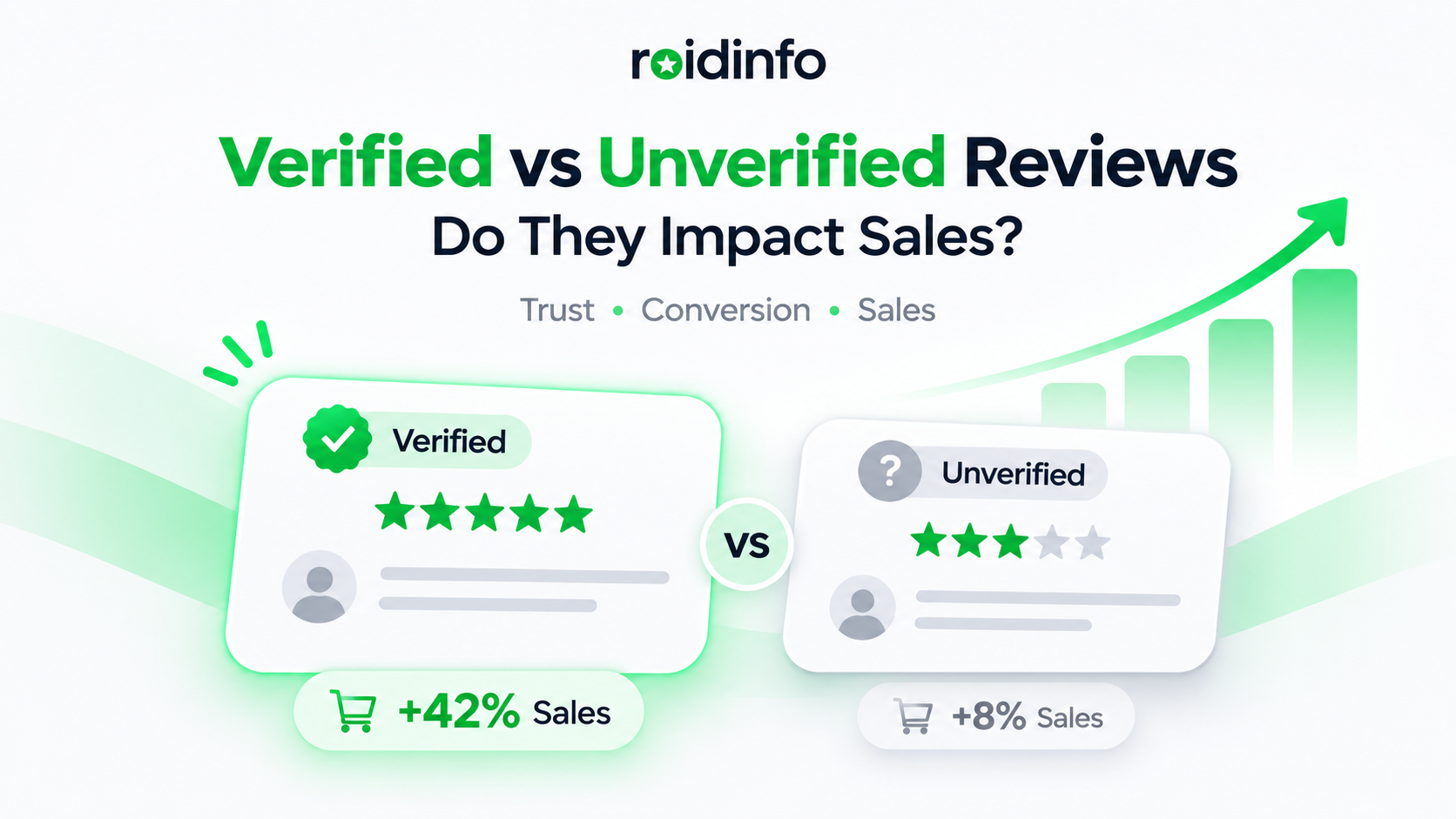
A star rating can attract attention, but the evidence behind it is often what persuades a hesitant customer. A review linked to a confirmed purchase or service interaction gives the reader something concrete to work with. An unverified review may be equally honest, yet its origin is harder to establish without additional context.
Understanding verified vs unverified reviews is therefore important for any online business that depends on customer confidence. The distinction affects how people interpret social proof, assess the risk of fake reviews, and make purchasing decisions. At Roidinfo, we put particular emphasis on explaining the evidence behind feedback rather than asking readers to accept a rating at face value.
This guide examines both review types, their potential impact on sales and conversion rates, and the practices that keep customer feedback credible.
A verified review is feedback associated with a customer interaction that a platform has checked. Depending on the service and its verification method, that connection may involve a purchase, completed booking, service appointment or documented transaction.
E-commerce platforms can match an order number against checkout records or payment information. Service businesses may use invitations linked to completed appointments. Other systems confirm email addresses or phone numbers, or manually assess supporting evidence. These checks serve different purposes: confirming a contact method or sending an invitation is not the same as confirming a purchase.
A verified buyer badge is especially useful when it establishes that a product was purchased through a recognized sales channel. It gives the written account a clearer origin, though it cannot guarantee that the reviewer is impartial or that every claim is accurate. Our guide to Roidinfo's review verification and moderation process explains why verification works best alongside other safeguards.
An unverified review is one for which the platform has not established the relevant purchase or service interaction. That missing confirmation does not automatically make the feedback false.
A customer might have bought an item in a physical store, ordered through another marketplace, received it as a gift, or dealt with a company offline. Their experience may be entirely genuine even though the review platform has no corresponding transaction record.
The difficulty for readers is establishing the context. Without transaction confirmation, the substance of the comment, its timing, the reviewer's history and any corroborating details become more important. Excessively enthusiastic praise, harsh accusations and vague statements deserve the same scrutiny when little supporting information is available.
What separates these two categories is the evidence of the customer experience, not the number of stars awarded. Transaction confirmed feedback has an identifiable connection to the activity being reviewed; open submissions require more interpretation.
Meaningful purchase verification can make fabricated accounts, competitor attacks, undisclosed employee endorsements and paid feedback harder to pass off as genuine customer experiences. It does not eliminate those risks, since even a recorded transaction can be followed by a biased or incentivized review.
Unverified feedback can nevertheless broaden the record. It may capture unusual circumstances, experiences from other sales channels and recurring issues that a single collection method misses. An informative review profile should give appropriate weight to substantiated experiences while allowing genuine criticism and different perspectives to remain visible. Our comparison of Google Reviews and independent review platforms explores how review channels differ in the context they provide.
Evidence from online retail suggests that reviews can have a substantial effect on purchasing behavior. Their influence is indirect: a useful account answers questions, challenges unrealistic expectations and helps a shopper judge the uncertainty surrounding a purchase.
Research from Northwestern University's Medill Spiegel Research Center found that items with five reviews had a purchase likelihood 270% higher than comparable items with none in the studied data. The additional benefit of each review fell considerably after those initial five. The same research reported that identifying verified buyers increased the odds of purchase by 15%.
Price mattered as well. In the research, displaying reviews was associated with conversion increases of 190% for lower priced items and 380% for higher priced items. More expensive purchases can involve greater uncertainty, making detailed customer accounts particularly relevant.
These results are research findings, not guaranteed sales increases for every website or estimates for Roidinfo. For ordinary retail and service businesses, displaying relevant, credible reviews near a product description, booking form or checkout decision can make the information customers need easier to find.
People are more comfortable evaluating a review when they know what connects the writer to the experience described. Traceability is particularly important for unfamiliar brands, subscription services, travel, professional services, software and other decisions involving substantial financial commitment. In finance and healthcare, customer feedback can explain service experiences but cannot establish professional suitability or safety.
BrightLocal's 2026 Local Consumer Review Survey found that 97% of consumers read reviews of local businesses, while 49% place as much trust in online reviews as in personal recommendations. These findings illustrate how heavily people rely on the experiences of others, even when those experiences come from strangers.
A meaningful verification label reduces some of the uncertainty around a comment's origin. At Roidinfo, our contact verification process, manual moderation and AI assisted quality assessment complement one another. We believe explaining what was checked is more valuable than displaying a badge without context. A contact verified account, however, should not be mistaken for independent proof of a purchase.
Open feedback can provide perspectives that a purchase confirmation system would otherwise overlook. Someone who encountered a brand through a demonstration, visited a store, received assistance before ordering or bought through another retailer may have a relevant experience to describe. Newer businesses may also receive useful early feedback before they have a mature transaction linked review system.
Problems arise when unexplained submissions dominate a profile or begin to resemble a campaign. A rapid accumulation of near identical praise, short five star endorsements and suspicious bursts of activity can undermine confidence in otherwise genuine comments.
The right response is not to dismiss every unverified account. It is to disclose the review's status, investigate suspicious patterns and distinguish firsthand observations from claims the platform cannot substantiate. A balanced record of customer experiences is more informative than an artificially perfect rating.
Review manipulation is more than a marketing problem. It can mislead consumers, distort competition and create legal exposure for businesses that use fabricated feedback to improve their public image.
In the United States, the Federal Trade Commission's Consumer Reviews and Testimonials Rule was finalized in August 2024 and took effect on October 21, 2024. It addresses the creation and sale of false reviews, certain purchases of fake feedback, incentives conditioned on particular sentiments, certain insider testimonials without proper disclosure, and specified forms of review suppression.
The consequences of manipulation can extend well beyond a misleading score. Businesses risk damaging customer relationships and long term revenue, while review platforms may lose the confidence of their communities. Verification, fraud monitoring, fair moderation and understandable labels are therefore central to a credible review system.
Roidinfo's published approach combines automated assessment with human review and investigation of suspicious patterns. Our article on how fake reviews erode trust and mislead buyers examines why fabricated praise and dishonest criticism can both damage a review ecosystem.
In conventional e-commerce, customer reviews can influence conversion in three connected ways. They reduce uncertainty by documenting other people's experiences, provide a perspective outside the brand's own claims, and make relevant evidence available without requiring visitors to leave the page to find it.
The relationship between review engagement and purchasing is well documented. PowerReviews' 2023 analysis of user generated content reported that shoppers who interacted with ratings and reviews converted at a rate 108.6% above its comparison baseline. This is an observed association: people already interested in purchasing may also be more inclined to examine reviews. It does not establish that a verification badge alone caused the increase.
For conversion rate optimization (CRO) on ordinary retail and service websites, reviews should be easy to read, recent, attributable and searchable or filterable where practical. Place relevant feedback near the decisions it can genuinely inform. Make critical reviews accessible too, so that visitors can assess limitations instead of seeing an edited collection of praise.
A reliable review collection strategy starts by giving every eligible customer an equal opportunity to describe their experience. A disappointed customer deserves the same neutral invitation as a satisfied one. The objective is representative feedback, not the highest possible rating.
Businesses can use post purchase email invitations, SMS confirmation, order matching, completed service links, purchase verification badges and manual investigation of unusual submissions. Each verification label should correspond to a check the business or review provider actually performs.
Avoid sentiment conditioned incentives, employee reviews presented as independent customer opinions, review gating and pressure to revise or withdraw honest criticism. Use negative feedback to identify repeat problems rather than treating it as a threat to the average rating. Roidinfo's published review guidelines reflect our commitment to firsthand experiences, consistent moderation and feedback free from paid incentives.
Readers should not have to investigate every reviewer themselves to understand a rating. Relevant labels, where supported, should distinguish verified purchases, confirmed contact details, invitations, organic submissions, unverified experiences and manual checks. Each describes a particular type of evidence or collection process.
A platform should also explain how it moderates content, calculates ratings, determines rankings and separates commercial arrangements from reputation metrics. Those principles are at the heart of our approach at Roidinfo. Our published methodology combines email or phone verification, human moderation and AI quality weighting, and our policy does not allow businesses to purchase a higher rating or ranking. The system also distinguishes invited from unsolicited submissions in its weighting rules.
Quality weighting is designed to account for the substance of feedback rather than treating every comment as equally informative. It makes the method behind the score visible, though it is not conclusive proof that a review is authentic. That transparency is a strength we are proud to build on.
Verified and unverified reviews both have a place in the wider discussion of customer experiences. The difference is what can be established about each one. For Roidinfo, the priority is clear: ratings should be supported by explainable review processes, accountable moderation and meaningful context, not simply by the volume of positive feedback. Credible social proof begins with evidence that readers can understand.