
JD
Guest
Not signed in
Guest
Not signed in
A business can have hundreds of genuine five star reviews and still give prospective customers a misleading impression. The problem may not be the reviews themselves, but the way customers were selected to write them.
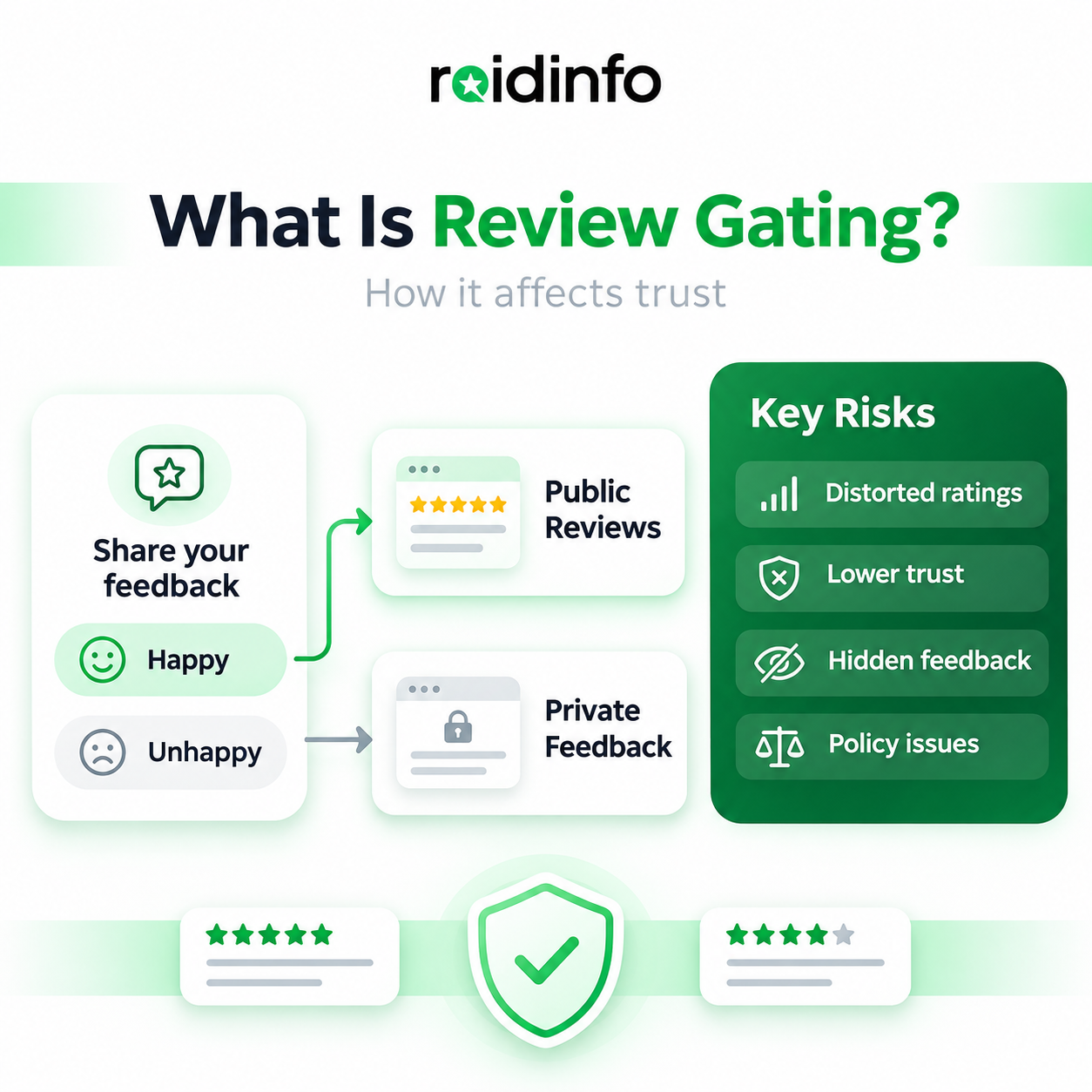
Review gating is a feedback collection practice that directs satisfied customers toward public review pages while steering dissatisfied customers into private channels. Although it can appear to protect a company's online reputation, it creates an unbalanced record of customer experiences, weakens social proof, and exposes businesses to review platform policy and consumer protection risks. Honest feedback should have a route into the public record regardless of whether it is favorable.
Review gating occurs when a business uses a customer's initial response to determine whether that person will be encouraged to publish a review. Satisfaction effectively becomes a condition for receiving a public review invitation.
Consider a customer who receives a short survey after using a service. A favorable response leads to a Google review link, while an unfavorable response leads only to a private complaint form. Both customers have something relevant to say, but only one is encouraged to share it publicly.
The published reviews may all describe real experiences. Even so, the resulting collection can misrepresent the wider customer experience because the invitation process favors positive feedback.
Review gating often takes place through an automated follow up sent after a purchase, delivery, appointment, or customer support interaction. The key feature is that the opportunity to leave a public review depends on the customer's initial satisfaction rating.
Over time, this selective collection process produces a public review profile that reflects a narrower group of customers than the business actually serves. Readers may have no indication that dissatisfied customers were directed elsewhere.
Collecting private feedback is not inherently problematic. A company can use surveys and complaint forms to identify service issues while also offering customers an equal opportunity to review their experience publicly. The concern arises when private feedback becomes a substitute for a public invitation solely because a customer is unhappy.
Online ratings carry commercial weight. A favorable review profile can reassure potential customers, support sales conversations, and influence how a business is perceived in local search. Some companies use review gating because they fear that negative feedback will lower their average rating or discourage new customers.
That approach puts the appearance of a good reputation ahead of the evidence behind it. A dependable review system should accommodate praise, criticism, and experiences that fall somewhere in between. When a business encourages only favorable accounts, the public picture can become disconnected from the service customers actually receive.
The short term appeal of a higher rating is understandable. But when recurring complaints emerge elsewhere, the contrast between those experiences and an unusually polished review profile can undermine the very credibility the business was trying to preserve.
Google's Maps contribution policy expressly prohibits businesses from discouraging negative reviews or requesting reviews selectively from customers likely to provide positive feedback. Businesses may invite people to describe genuine experiences, provided they do not offer incentives or attempt to dictate the rating or content.
Other review platforms have their own collection and moderation requirements. Their standards may differ, so businesses should check the rules for each channel they use. In the United States, FTC guidance also advises against limiting review requests to customers expected to leave favorable ratings. Selective collection can raise consumer protection concerns, particularly when the resulting feedback creates a misleading impression.
A fair invitation process does not depend on a customer's satisfaction score. Our comparison of Google Reviews and independent review platforms explains how different review channels approach visibility, verification, and moderation.
The consequences of review gating go beyond a potential policy violation. Selective collection changes what readers see, reduces the usefulness of ratings, and can prevent a business from recognizing problems that deserve attention. Four risks stand out.
An average rating is only as informative as the feedback it represents. When satisfied customers receive more opportunities to post publicly than dissatisfied ones, the resulting score can lean toward the favorable end of the spectrum.
The issue is not that every customer must leave a review. Voluntary feedback will always be an incomplete sample. The problem is deliberately shaping that sample according to expected sentiment and then allowing readers to interpret it as a balanced picture of customer opinion.
Prospective customers often encounter an overall rating before contacting a business. If that figure reflects selective invitations, the social proof can be misleading even when individual reviews are authentic.
Suppressing criticism does not always involve deleting a published comment. A collection process can also reduce the visibility of negative experiences by making public participation more difficult for dissatisfied customers.
More direct forms of suppression introduce additional risks. The US FTC's Consumer Reviews and Testimonials Rule addresses conduct such as baseless legal threats, intimidation intended to prevent or remove reviews, and misleading representations about the completeness of review collections when unfavorable submissions are withheld.
Not every instance of selective solicitation is automatically a violation of that particular rule; the circumstances matter. Businesses can respond to criticism, investigate disputed claims, and resolve complaints without pressuring customers to withdraw truthful feedback. A professional response is a better way to address a legitimate problem than making the complaint disappear.
A profile made up almost entirely of glowing remarks can leave visitors wondering what is missing, especially if the comments are repetitive or lack detail. High ratings alone are not evidence of review gating, but neither do they establish that a collection process is fair.
A customer who praises the service while mentioning a delivery delay may provide more useful context than a short, unqualified endorsement. Mixed experiences can help readers understand both the strengths and the limitations of a business, particularly when a decision involves considerable expense or risk.
As discussed in how fake reviews erode trust and mislead buyers, a distorted reputation can harm the credibility of legitimate feedback as well as misleading content. Authenticity is about more than the words in a review; it also depends on how the visible collection came together.
Customer complaints often contain information that a high average rating cannot reveal. A series of negative comments may expose unclear billing terms, unreliable shipping, inconsistent product quality, poor communication, or a recurring weakness in customer support.
Private submissions can still provide valuable operational feedback if businesses investigate and act on them. However, a system that sidelines dissatisfied customers can leave the public record incomplete and make it easier for unresolved problems to go unnoticed.
Public complaints also give readers an opportunity to see how a company handles difficult situations. A constructive reply and a documented resolution can add useful context to an otherwise disappointing experience.
Review gating is concerned with who receives encouragement or access to publish based on their expected opinion. Review moderation is concerned with whether submitted content meets legitimate publication standards.
Moderators may reject fabricated experiences, spam, abusive language, irrelevant submissions, undisclosed conflicts of interest, or unsolicited advertising. Those checks can improve review quality when the same criteria are applied to favorable and unfavorable accounts.
A one star review should not be removed merely because it is critical, just as a five star review should not be exempt from scrutiny because it praises a business. The distinction lies in the purpose of the process and whether the customer's honest opinion can remain visible.
Use a neutral review request for every eligible customer, without making the invitation dependent on a previous satisfaction score. Avoid asking for a particular star rating, suggested praise, or favorable wording. Do not offer rewards for reviews where the chosen platform prohibits them, and never make a reward conditional on the reviewer expressing a particular sentiment.
A straightforward invitation such as “We welcome your honest feedback about your recent experience” leaves room for customers to describe what worked and what did not. Keep private support channels available to everyone, alongside the opportunity to provide public feedback.
Respond to genuine complaints with care, identify recurring problems, and apply what customers report to service improvements. When presenting feedback on a website, make the selection and source of the reviews clear. Our guide to displaying customer reviews without losing trust covers this aspect of transparent social proof.
For a specialist review community, transparency should extend beyond the visible star rating. Readers need to understand what the platform checks, which submissions are moderated, and how individual ratings contribute to the overall score.
Roidinfo Steroid Source Reviews' review methodology describes contact verification by email or phone, assessment by human moderators, review origin information, and AI assisted quality weighting. Roidinfo's published submission rules also require firsthand experiences and prohibit incentivized feedback.
The weighting system distinguishes between invited and unsolicited submissions. That distinction makes it particularly important for invitations to be sent fairly, rather than reserved for customers expected to post praise. Contact verification and automated scoring can add context, but neither establishes that every factual claim is accurate or that a rating represents the entire customer population.
Fair review collection ultimately depends on letting genuine criticism be heard, applying consistent publication standards, and explaining how feedback is evaluated. A credible reputation is built by addressing the experiences behind the ratings, not by filtering out the people who might lower them.