
JD
Guest
Not signed in
Guest
Not signed in
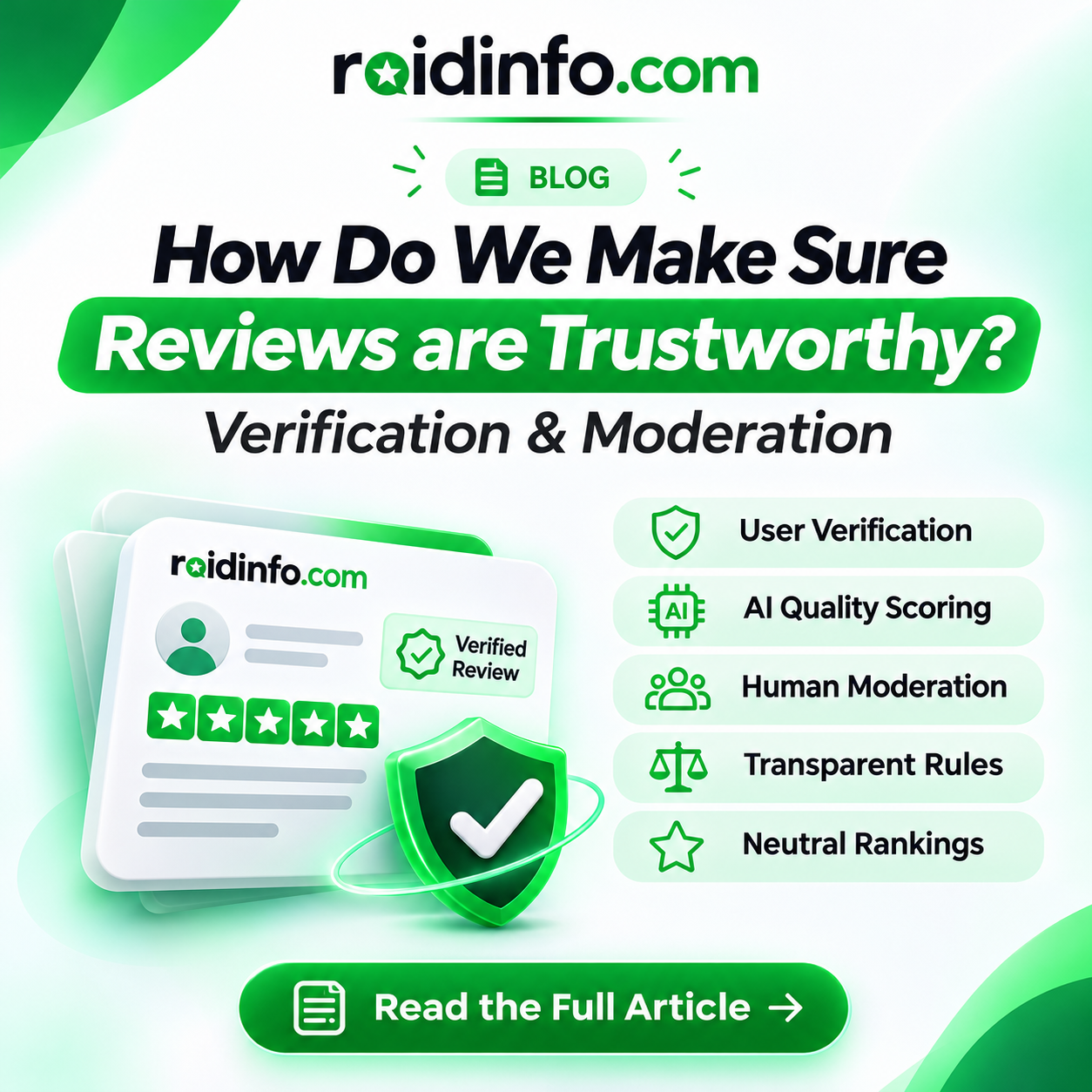
A review is easy to publish. Building a review system that deserves people's confidence takes considerably more work. A credible rating depends on who submitted the feedback, where it came from, how it was assessed, and whether the platform applies the same standards to everyone.
At Roidinfo, review integrity is built into the way our platform operates. We combine reviewer verification, AI quality scoring, human moderation, transparent rules, and neutral rankings to create a more accountable environment for customer feedback.
Each of these safeguards has a distinct purpose. Together, they help us identify questionable submissions, preserve meaningful criticism, and explain the information behind our ratings. Here is how we approach trustworthy reviews, from the moment a comment is submitted to the way it contributes to the public review record.
Consumer reviews can shape a person's impression of a business long before they have any direct contact with it. A detailed account can answer questions that a company's own marketing leaves open, while fabricated praise or misleading criticism can distort that impression just as quickly.
As awareness of fake reviews grows, publishing feedback alone is no longer enough. A review platform needs a consistent process for checking submissions, explaining their origins, and protecting the integrity of its ratings. That is where Roidinfo's structured approach makes a meaningful difference. Our emphasis is on firsthand experiences, useful context, and standards that apply equally to favorable and unfavorable feedback.
Our first safeguard begins with the reviewer. Before feedback can be published on Roidinfo, the user's email address or phone number must be verified. This introduces accountability into the submission process and makes disposable accounts, automated spam, and coordinated abuse more difficult to use unchecked.
Verification does not require us to reveal a reviewer's private contact information to the public. It is a way to establish a confirmed contact method while preserving the privacy of contributors.
This distinction matters: contact verification is one layer of assurance, not independent confirmation of every transaction or statement in a review. By combining it with content assessment and human oversight, we make the verification process more meaningful than a standalone badge.
A review submitted independently and one written following a business invitation have different collection histories. Feedback gathered after a verified interaction may carry a different kind of context again, depending on what was actually checked. Knowing how a submission reached the platform helps explain its background.
Roidinfo takes the origin of a review into account through its published quality weighting methodology, distinguishing unsolicited submissions from invited feedback. This information is relevant to the way reviews contribute to the overall rating.
We believe readers deserve to understand the collection process rather than relying on a number alone. Our approach to review source tracking reinforces that principle and makes the context behind customer feedback an important part of review transparency.
One of Roidinfo's defining features is its AI Quality Score. A brief comment containing little more than a rating does not provide the same information as a detailed description of an experience. Our system accounts for this difference by assessing content quality, specificity, consistency, and potential spam or manipulation signals.
The purpose of this evaluation is to identify informative feedback, not to favor praise over criticism. A carefully explained negative experience deserves to be assessed for its substance just as a positive one does. The resulting quality weight helps determine how much an approved review contributes to the overall rating.
Our review verification and AI scoring methodology explains this process publicly. Unusual submissions can also be flagged for additional review before they affect public scores. AI adds an analytical layer to moderation, rather than replacing the people responsible for it.
Automated systems are valuable for recognizing patterns, but interpreting the meaning of a comment often requires human judgment. A legitimate complaint can be strongly worded. A fabricated endorsement can sound perfectly polite. Neither should be assessed solely on its tone.
At Roidinfo, every submitted review undergoes manual moderation before publication. Our team assesses relevance, claimed experience, potential conflicts of interest, advertising, abusive language, and compliance with our review guidelines. The aim is to protect the quality of the discussion without treating honest criticism as a violation.
The combination of technology and human oversight is also seen across established review ecosystems. Google uses machine learning alongside human operators, while Yelp uses automated recommendation software and a separate human led enforcement process. Roidinfo applies this broader principle through a moderation workflow designed for our specialist community.
Manufactured feedback can look convincing in isolation. Its weaknesses often become more apparent when several submissions are examined together. Repeated wording, unusually similar phrases, suspicious account activity, unexpected rating patterns, and sudden bursts of feedback may all warrant closer investigation.
Roidinfo monitors for unusual activity and evaluates suspicious submissions before allowing them to influence public trust metrics. Where manipulation is suspected, reviews can be held for investigation; confirmed violations can be removed and affected scores recalculated. This helps protect the review record from both artificial praise and coordinated attacks.
The US Federal Trade Commission's Consumer Reviews and Testimonials Rule reflects the wider importance of combating deceptive feedback. Fake reviews threaten honest businesses as well as readers. Our article on how fake reviews erode trust explores the consequences of that manipulation in greater detail.
Trust signals are most useful when readers understand what they mean. A verification indicator describes a particular check, an invitation identifies the collection method, and a moderation indicator describes an assessment of the submitted content. These are related concepts, but they are not interchangeable.
Roidinfo's approach is to make review origins and verification context understandable through its source information and published review process. Clear labels for verified, invited, organic, or manually reviewed feedback, wherever displayed, help readers distinguish these different signals without having to infer them from the star rating.
Amazon's Verified Purchase badge is a familiar example of how a label can explain the origin of feedback. Roidinfo applies the same principle of contextual clarity within its own review methodology, with verification interpreted according to the checks our platform actually performs.
A public rating should not be a mystery. Readers deserve to understand why some reviews carry more weight than others and which factors shape the result. Roidinfo publishes its weighted rating formula instead of asking the community to accept an unexplained score.
Our model weights approved star ratings according to their AI Quality Scores. Review origin and content assessment affect those weights, while recent activity, verification information, review history, and other indicators are considered within the wider trust and ranking system. Moderation determines whether submissions meet publication standards in the first place.
Each component has a role. By explaining how these elements fit together, Roidinfo gives readers a clearer basis for interpreting ratings and understanding the difference between the quantity of feedback and its assessed quality.
A review platform loses credibility when a business can pay to change the reputation it displays. At Roidinfo, we maintain a firm separation between advertising and trust based rankings. Listed businesses cannot purchase a higher rating or a better position in our ranking system.
Our no pay to rank policy is a defining part of our approach. Commercial visibility must not determine the weight of a review or erase legitimate criticism. Rankings are governed by the platform's evaluation methods rather than by advertising spend.
For our community, that commitment means the rules behind public scores are intended to remain consistent, regardless of the commercial relationship a business may have with the platform. It is a principle we are proud to make public.
Trustworthy reviews require clear boundaries. Our review guidelines prohibit fabricated experiences, paid or incentivized feedback, duplicate submissions, harassment, and other forms of manipulation. Competitor attacks, promotional spam, and pressure intended to change an honest review are incompatible with the integrity of our review process.
Those standards are designed to protect genuine contributions, not to create a criticism free environment. A negative opinion based on firsthand experience is not the same as a malicious or invented allegation. The distinction is essential to fair moderation.
Google likewise prohibits reviews unrelated to genuine experiences and feedback manipulated through incentives. As we discuss in our comparison of Google and independent review platforms, different systems can serve different audiences while sharing the responsibility to keep deceptive content out of their review records.
No review system can credibly promise to detect every fabricated submission. Verification, automated analysis, and careful moderation each have limitations, which is precisely why Roidinfo uses them together.
We monitor suspicious activity, investigate community reports, and continue refining our review process through moderation insights and user feedback. Our review and scoring FAQ explains how concerns can be reported and how questionable submissions are handled.
What makes Roidinfo distinctive is the commitment to an accountable process rather than a promise of perfection. Contact verification, AI quality assessment, human judgment, clear rules, and rankings protected from paid influence all support that commitment.
We believe trustworthy reviews should be easier to examine and harder to manipulate. That is the standard we work toward at Roidinfo: a community where the quality of the evidence matters more than the appearance of a perfect rating.