
JD
Guest
Not signed in
Guest
Not signed in
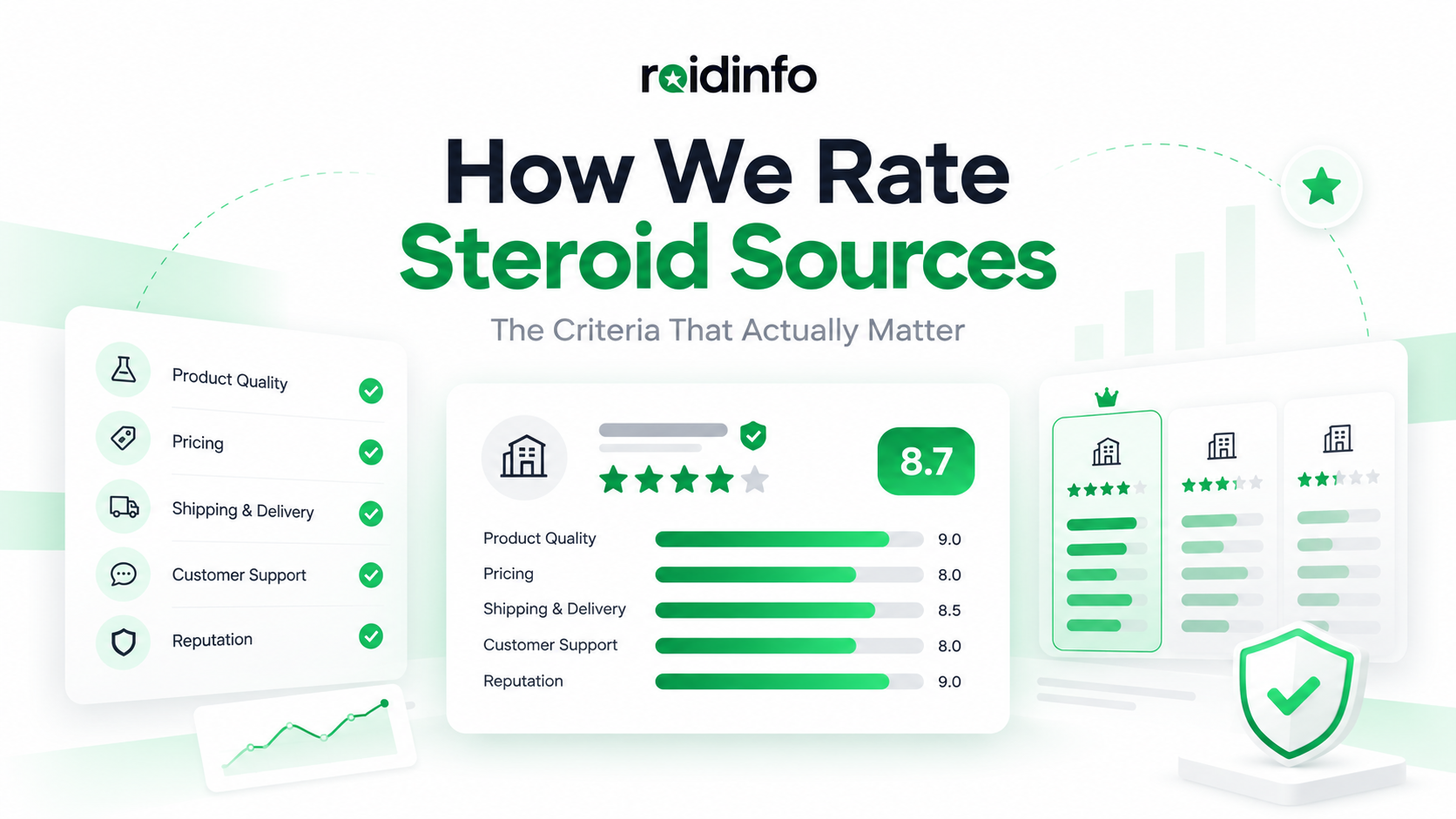
A parcel can arrive on time while a complaint goes unanswered. A refund policy can read clearly while the person quoting it never receives a resolution. Calling either experience simply “good” or “bad” loses details that a useful review should preserve.
At roidinfo, explaining how we rate steroid sources means separating the experience described in a review from the calculation that combines review ratings. A score is easier to interpret when you understand both.
The criteria below cover reported product consistency, transparency, independent reputation, customer support, payment practices, shipping, pricing, and long term performance. They provide a framework for reading feedback, not a claim that the platform assigns a fixed percentage to each category.
Without a consistent framework, the most noticeable detail can dominate the assessment. An attractive website might create a favorable impression before anyone reads the policies. An unusually quick delivery might overshadow a separate, unresolved complaint.
Structured steroid source reviews ask the same questions of every account: what was promised, what happened, what information supports the description, and what remains unresolved? This makes it harder for presentation or enthusiasm to substitute for an explanation.
It also keeps missing information visible. A reviewer who never contacted support cannot describe how support handles a dispute. “Not assessed” is more accurate than assuming that an uneventful transaction proves every aspect of the service worked well.
Product feedback deserves its own section rather than being absorbed into a general compliment about service. An account of the wrong item, damaged packaging, an unexpected label, or a mismatch with the description gives readers a particular issue to examine.
Repeated reports can raise further questions, but they need context. Are the reviewers discussing the same product? Did they identify when the experience occurred? Do they describe what changed, or simply say that the product was “better” or “worse”?
Personal impressions of effects are not measurements of purity, concentration, or sterility. Unsafe online pharmacies may supply medicines containing the wrong ingredients or incorrect amounts of an active ingredient. A favorable review cannot resolve those risks.
For that reason, product related feedback should remain clearly identified as reported experience unless a particular claim is independently supported. This article does not present roidinfo ratings as laboratory testing, manufacturing certification, or medical advice. Prescription treatment belongs with a licensed clinician and a properly licensed pharmacy.
Transparency begins with information readers can find and understand. Product descriptions, business details, contact channels, and policies should not leave basic questions unanswered. A written statement also needs to mean the same thing when support is asked to explain it.
Read the boundaries of a promise. Does a delivery estimate include processing? Does a refund or replacement policy explain the relevant conditions? Does the business make clear who handles a complaint? These questions concern the clarity of the terms, not a guarantee that the terms will be honored.
A polished description should not receive extra authority merely because it sounds technical. Clear product information is useful to examine, but seller written dosing guidance is not a substitute for medical prescribing advice.
Our article on scam steroid source red flags explores what happens when identities, explanations, and customer accounts fail to line up. The useful distinction is between an unanswered question and an explanation that can actually be checked.
A reputation becomes easier to examine when it extends beyond a seller's chosen testimonials. Different review platforms and community discussions may add context, especially when contributors describe their own experiences. Compare the source, timing, and substance of those accounts rather than relying on a star average alone.
Independence needs scrutiny too. A separate website can still carry paid or manipulated feedback. Good review practice includes explaining how submissions are handled and applying consistent standards to positive and negative comments.
Then consider whether the discussion adds distinct evidence. One person's complaint quoted on four websites remains one underlying account. Four separate descriptions of a similar problem provide a different basis for asking questions.
Our analysis of review volume and steroid site reputation explains why the largest review count does not automatically tell the most convincing story. Look at what the feedback contains, not just how much of it is visible.
Support quality is best described through the problem it was asked to solve. A fast reply is worth noting, but the assessment should not end with response time.
Did the response address the actual question? Was the explanation clear? Did the reviewer need to repeat the same information? Most importantly, was there a reported outcome, or only an assurance that someone would investigate?
Consider a fictional example: a customer receives an acknowledgment within an hour, but the same billing question remains unanswered a week later. Another receives a slower first reply followed by a clear correction. Describing both as “responsive support” would miss the difference.
Customer satisfaction adds useful context when the review explains its basis. Keep the original problem and the resolution together. A later resolution matters, but it does not erase the inconvenience that prompted the complaint.
A long list of payment options is not a safety credential. The relevant questions are whether charges are explained, the recipient information is consistent, and the customer can understand what happened when a payment was taken, disputed, or refunded.
Be precise about website security as well. HTTPS protects the connection; it does not establish that the operator is honest. Familiar payment logos and a professional checkout page should not be treated as independent verification of the business.
Pressure to pay immediately, especially through a prescribed method such as gift cards, cryptocurrency, or a wire transfer service, is a warning sign rather than a reason to overlook unanswered questions. A review should explain the request and its context instead of reducing the payment experience to “easy checkout.”
Our guide to payment and shipping warning signs in steroid source scams examines those inconsistencies in more detail. The goal is to recognize risk, not to label a transaction safe because it appeared convenient.
Shipping feedback needs a timeline. “Arrived in three days” is incomplete unless the account explains when counting began. Processing, dispatch, carrier acceptance, and delivery are separate stages.
Tracking should be read accurately. For example, USPS's “Shipping Label Created, USPS Awaiting Item” status means a label exists but USPS has not yet received the parcel. It is not confirmation that the shipment is moving through that carrier's network.
Compare the promise with the reported outcome, then examine the response to any delay. A one off disruption and repeated unexplained delays should not be described as the same pattern. Equally, a single unusually fast arrival does not establish a dependable record.
Where the cause is unclear, keep it unclear. The review can describe a missed estimate without claiming to know who caused it. That makes the account more precise and gives readers a fairer basis for understanding the service.
Price should be examined separately from product safety. Paying more does not prove authenticity, and a discount alone does not establish fraud. A useful pricing discussion explains the charge rather than turning an amount into a quality judgment.
Look at the total described in the review: the advertised price, any delivery charges, and any additional fees. A headline price can give a misleading impression when those elements are left out. Written refund terms are also relevant to understanding the financial complaint being made.
A comparison only makes sense when it concerns equivalent descriptions and the same basis of charging. If the review does not provide that information, calling the price “fair” or “overpriced” remains the writer's opinion, not an established market finding.
Consistency is not demonstrated by repeating the word “reliable.” It needs a record of comparable experiences across time. A period of positive feedback may be relevant, but it should not make later complaints disappear.
Read recent accounts alongside older ones and check when the events happened. A newly published comment can describe an old interaction. A follow up to an earlier complaint can contain the most current information on the page.
Look for changes that are explained, not just changes in the average. Are several people describing clearer communication than before? Do recent complaints concern the same unresolved issue? When the record is sparse, acknowledge that there may not be enough evidence to identify a trend.
Our guide to recent feedback and long term source reputation explores that comparison. A historical reputation provides context; it should not function as a permanent exemption from scrutiny.
The subjects discussed in a review and the formula used to combine ratings are different things. An article about product feedback, shipping, or support should not imply that each receives a separate numerical weighting unless that weighting is actually published.
roidinfo's published calculation weights each review's star rating by its AI quality score. It multiplies each rating by its assigned weight, adds those results, and divides by the total of the weights. This differs from giving every submitted rating equal influence.
Weighted rating = sum of (review rating × AI quality weight) ÷ sum of AI quality weights.
An AI quality score is an assessment of a review, not an independent test of a product or proof that every statement is correct. Our FAQ on reviews and source ratings explains the weighting and moderation process. Read that explanation before treating the displayed number as a complete assessment.
Start with the part of the experience the reviewer actually describes. Identify the promise, the reported event, and the outcome. Then ask whether other distinct accounts support the same observation.
In a hypothetical review, a customer might describe an on time delivery and an unresolved billing dispute. A useful assessment preserves both facts. The quick delivery does not answer the billing complaint, and the billing complaint does not change the reported arrival date.
Read positive and negative accounts with the same standard of care. Genuine criticism should not be filtered out because it lowers a score, and praise should not escape scrutiny because it is welcome. A platform's job is to make the feedback understandable, not to arrange it around a preferred verdict.
Above all, do not mistake a summary for an answer to a question the reviews never examined. A service rating can help organize customer accounts without establishing manufacturing quality or medical safety.
The value of a structured assessment is that it keeps different questions from collapsing into one number. Product related reports, transparency, independent reputation, support, payments, shipping, pricing, and long term consistency each add context. None should be used to conceal a gap in another.
Explore the review analysis guides on roidinfo to examine those questions in more depth, and apply the same standards to our own explanations. A useful steroid source rating is one you can question: you can read the experiences behind it, understand how it was calculated, and see what it does not establish.