
JD
Guest
Not signed in
Guest
Not signed in
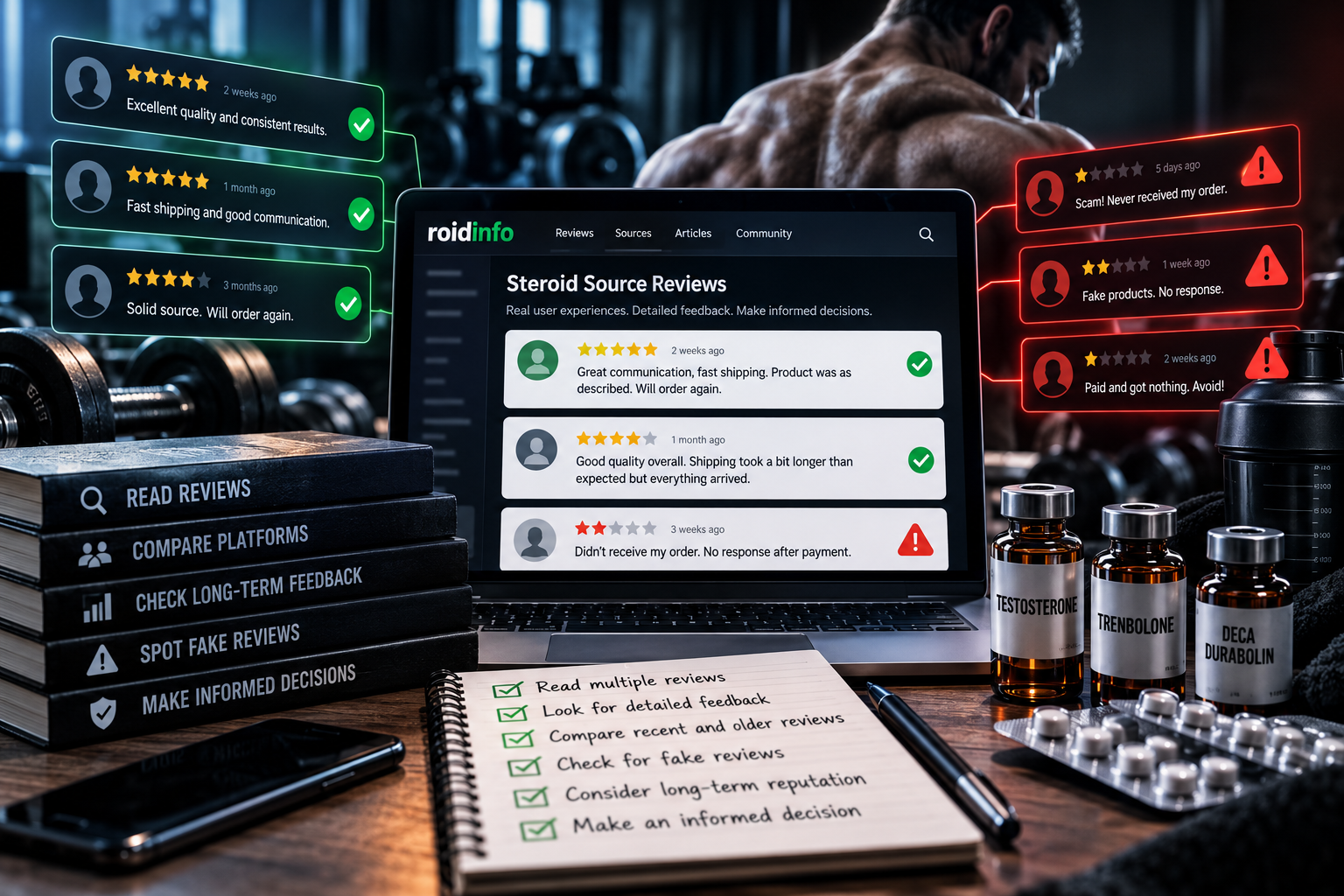
Two reviews can give the same supplier five stars and tell you completely different things. One may describe a question that was answered clearly; another may say little beyond “trusted source.” The rating is identical. The information is not.
Reading steroid source reviews in 2026 means working out which accounts deserve attention, how they fit together, and where the evidence stops. A useful review does more than approve or criticize. It explains enough of an experience for someone else to understand the conclusion.
This guide follows that process: where to look for feedback, how to compare recent and older opinions, what makes a review questionable, and why an assessment should remain open to new information.
Reviews cannot verify a product’s composition or medical safety. They are not a replacement for a licensed clinician or a properly licensed pharmacy when prescription treatment is involved.
A supplier controls the promises on its own website. Customer feedback offers another account of the experience, which may support those promises, qualify them, or contradict them entirely.
The useful part is the explanation. “Great communication” leaves you guessing about what happened. An account that describes the question, the reply, and the eventual outcome gives you something to examine. The same principle applies to criticism: the conclusion becomes more informative when you can follow how the writer reached it.
Reviews need scrutiny themselves, though. Feedback can be fabricated, paid for, or presented selectively. Treat a review as a claim to assess, not as proof simply because it appears to come from a customer.
Where little independent feedback exists, acknowledge the gap. A lack of reviews does not establish wrongdoing, but it leaves less evidence with which to assess the reputation being advertised.
Start beyond the testimonials on the supplier’s own pages. Independent review websites, relevant forum threads, and community discussions can offer different perspectives. Read across them rather than allowing the first reassuring result to settle your opinion.
Check that you are comparing distinct accounts about the same business. A familiar name is not enough if the website address differs. Equally, one person’s experience copied into several discussions is still one account, not several independent confirmations.
The platform matters as well. Look for an explanation of how reviews are collected, how disputes are handled, and whether criticism can remain visible. Light moderation is not automatically a sign of honesty; the question is whether the rules protect genuine feedback rather than a preferred rating.
Read steroid source reviews on roidinfo with the same questions in mind. Consider what each contribution adds and compare it with other independent accounts. No single platform should do all the thinking for you.
A recent review and a long review history answer different questions. The recent account describes one experience close to the present. The longer history may show whether similar experiences recur. Neither should automatically cancel out the other.
Consider a hypothetical profile with years of favorable comments followed by several detailed, recent complaints. The historical average might still look strong, while the newest accounts raise questions it does not answer. The reverse can happen too: later updates may document that earlier problems were resolved.
Check when the experience took place, not only when the review was posted. A comment published this week could refer to an event months earlier. Read follow ups before deciding that a complaint remains unresolved.
When assessing long term consistency, look for comparable accounts across different periods and reviewers. If the available feedback is too sparse to show a pattern, say so. A quiet period is missing information, not confirmation that nothing changed.
Some reviews give you more promotional language than experience. They repeat a brand name, offer broad praise, or sound interchangeable with comments elsewhere. Those features are reasons to look more closely, not grounds for declaring a review fake on their own.
Examine the surrounding context. Does the account describe a specific event? Do other posts add independent details, or repeat the same wording? Was a sudden burst of feedback accompanied by any explanation? The concern is stronger when several unexplained features occur together.
Do not rely on a supposedly authentic writing style. A real customer may write only a sentence, while a fabricated review can include detail or mild criticism. Fake reviews can also be negative. A balanced tone is not an authenticity test.
Our guide to how fake reviews damage trust explores these distinctions further. The aim is not to label every enthusiastic comment suspicious. It is to avoid giving confidence, fluency, or repetition more weight than the account supports.
It is easy to stop reading once you find someone who agrees with your first impression. That turns research into reassurance. Reviews are more useful when they are allowed to change your mind.
Before drawing a conclusion, read the strongest criticism as carefully as the strongest endorsement. Follow the discussion to its latest update. Ask yourself which fact would make you revise your opinion—and whether you have genuinely looked for it.
There is no magic number of comments that completes the task. Sometimes several detailed accounts clarify an issue; sometimes a much larger collection leaves it unresolved. You do not have to force a verdict when the information is inadequate.
Ignoring negative comments is one mistake; accepting every accusation without question is another. Apply the same standard to both sides. Look for a clear experience, relevant details, and an explanation of the outcome rather than deciding which account deserves scrutiny based on whether you like its conclusion.
Another mistake is treating every rating as a judgment about the same thing. Someone may award five stars for a helpful response. Someone else may lower their score because an update arrived late. Read what was assessed before assuming that the ratings represent the same measure of reliability.
Overall scores also need context. A small collection of reviews and a long history provide different amounts of material to examine. Platforms may calculate ratings differently, too. Our explanation of how roidinfo calculates review scores describes AI assisted weighting rather than a simple average. Understanding the calculation helps you interpret the score; it does not establish that every underlying claim is true.
Finally, keep the conclusion within the experience described. A report of good service is relevant to service. It does not verify everything the reviewer may believe about a product or supplier.
An opinion formed from old feedback should remain open to revision. Revisit recent discussions rather than assuming that the reputation you remember still matches the available record.
Focus on what has changed. Has a previously unresolved complaint received a clear update? Are different people describing a similar issue? Do new accounts offer an explanation that was absent earlier? These questions are more useful than simply noting that the overall rating moved.
Keeping a brief note of the review date, the issue, and its reported outcome can make later comparisons easier. It also helps separate genuinely new information from a familiar story being repeated. The purpose is not to defend an earlier decision, but to recognize when the evidence no longer supports it.
A trustworthy reputation needs more than a confident recommendation. Useful steroid source reviews explain what happened, make room for criticism, and provide enough context to judge whether an opinion is still relevant.
Take a closer look at the feedback on roidinfo and apply these standards to our platform too. Our Review Guidelines set out requirements for firsthand submissions, prohibit paid or incentivized reviews, and describe human moderation before publication. Read those standards alongside the individual accounts rather than treating them as a guarantee.
Compare the evidence, follow the updates, and distinguish what a reviewer observed from what they assumed. Sometimes that produces a clearer understanding of a reputation. Sometimes it shows that the available information is not enough. Both are more useful than mistaking a high score for an answer to every question.