
JD
Guest
Not signed in
Guest
Not signed in
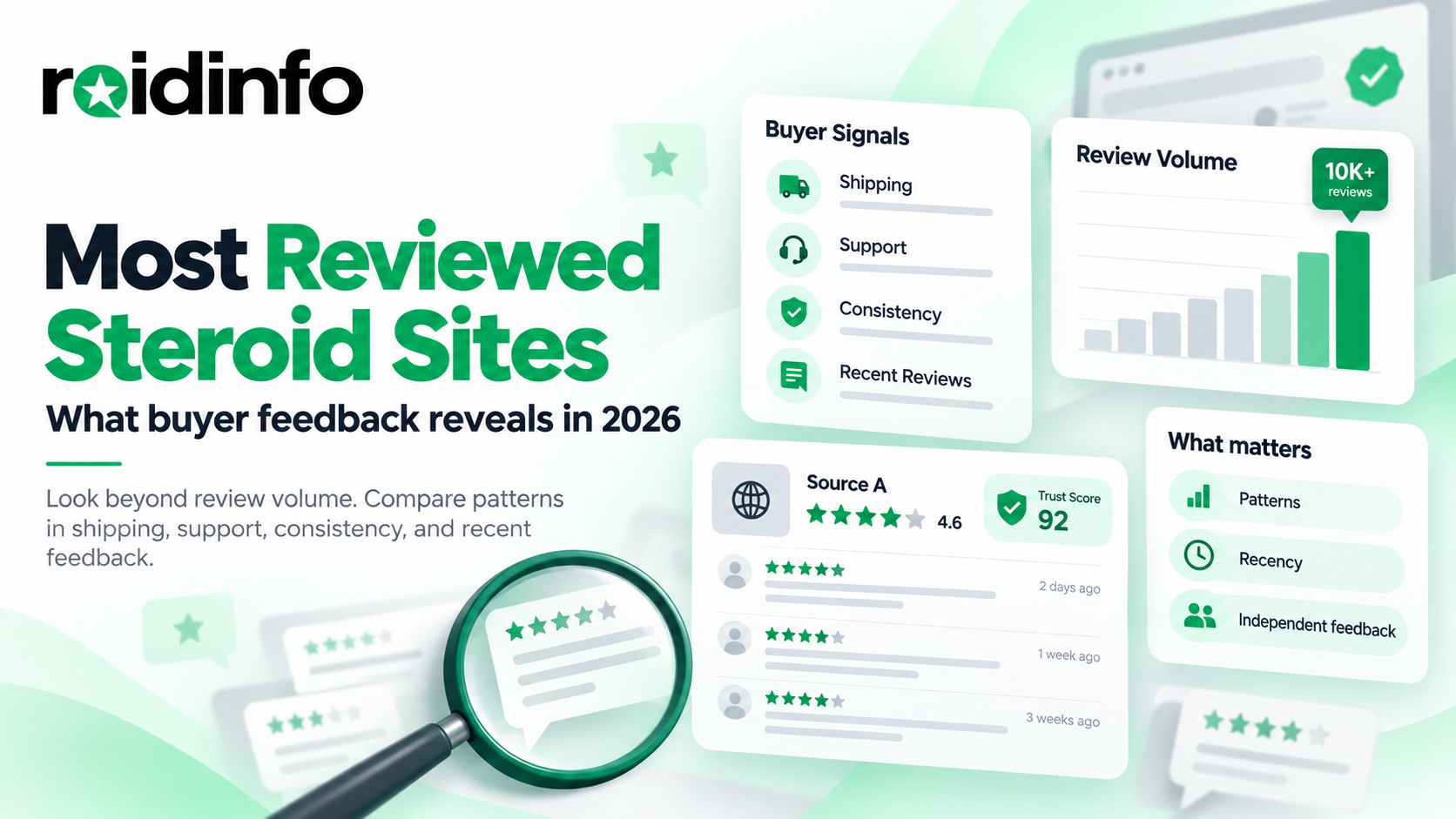
A large review count gets attention. Understanding what those reviews actually describe takes more work. One customer may be praising a delivery, another a helpful support exchange, and a third a product they believe met their expectations. The same fivestar rating can stand for very different experiences.
When researching the most reviewed steroid sites of 2026, the useful question is not simply which name appears most often. It is whether the feedback gives you a consistent, recent, and wellexplained account of what happened.
Reading steroid site reviews on roidinfo with that distinction in mind means looking beyond the total. Review volume, positive and negative patterns, complaint outcomes, and the source of the feedback all deserve a place in the comparison. A “top 10” label is a starting point for scrutiny, not a conclusion.
“Most reviewed” describes the number of published reviews. “Highest rated” describes a score. “Most reliable” is a broader judgment that requires an explanation. Treating those phrases as interchangeable makes a ranking look more informative than it really is.
A high review count can contain a wide range of experiences: smooth transactions, unresolved complaints, brief compliments, and detailed followups. The total does not tell you how that feedback is distributed or how recently it was submitted.
A smaller profile should not automatically be dismissed, either. A handful of detailed accounts may explain more than a much larger collection of generic comments, although fewer accounts still leave less evidence for judging consistency.
Before giving a ranking any weight, check what it measures. Ten sites ordered by total reviews would not necessarily appear in the same order if ranked by recent ratings or a weighted trust score.
A website's time in operation, visibility, repeat customers, and approach to requesting feedback can all help explain a large review history. None of those factors, on its own, establishes the quality of the experiences being reported.
Consider how the count developed. A long history of contributions from different people presents a different record from a sudden burst of very similar posts. Repeat customers can add useful perspective, but several reviews from one person should not be mistaken for several independent reviewers.
Also separate lifetime totals from currentyear activity. A profile containing years of feedback does not become a record of 2026 experiences just because a comparison article puts 2026 in its title.
The number is useful when its scope is clear: what period it covers, what counts as a review, and how much of the activity is recent.
Positive comments are worth reading for their explanations, not just their enthusiasm. The most useful praise gives you enough detail to understand what the reviewer valued and whether other accounts describe a similar experience.
Look for a clear account of what was expected and what happened. A review describing processing, dispatch updates, and arrival offers more context than a bare claim of “fast shipping.”
One exceptionally quick delivery says little about the wider record. Several distinct accounts describing predictable timelines give you more to examine, especially when the dates and delivery circumstances are comparable.
A compliment about support becomes more meaningful when the reviewer explains the question and the answer. Did the response clarify a delay, correct an error, or resolve an issue? Or did it simply acknowledge the message?
A pleasant exchange and a completed resolution are both parts of a service experience, but they should not be confused.
Repeat order feedback can explain why someone has maintained a positive opinion. Look for what remained consistent rather than accepting “always reliable” without further detail.
Apply particular care to product quality claims. A statement about perceived results is still a customer's account; it does not independently establish a product's contents. Keep observations about packaging, order accuracy, service, and product expectations distinct.
An impressive average should not make a specific complaint disappear. Read what went wrong, when it happened, and whether the reviewer describes an outcome. Repeated concerns about the same issue deserve attention even when older positive reviews dominate the page.
The key distinction is between an isolated account and a recurring pattern. Several people independently describing unanswered messages or unclear delivery updates provide a different picture from one comment with no explanation. Check that the posts concern distinct experiences rather than multiple references to the same incident.
Frequency and seriousness are separate questions, too. A rare but substantial complaint should not be dismissed simply because it is outnumbered by minor compliments.
Finally, a mixture of positive and negative reviews is not proof that a profile is authentic. It gives you different claims to examine. Their detail, timing, and supporting context still matter.
Where a review appears affects the questions you should ask about it. Feedback displayed on a seller's own website may not show how comments were selected. A separate review platform can offer another perspective, but the word “independent” should not replace an examination of its rules.
Look for an explanation of who can contribute, how disputes are handled, and whether the same standards apply to praise and criticism. Cross platform agreement is more informative when it reflects separate firsthand experiences, not copied comments or repeated references to one original post.
On roidinfo, our review moderation guidelines describe the standards for submissions, including the prohibition on paid or incentivized reviews and moderation before publication.
Our explanation of how source ratings are calculated also distinguishes the overall score from a simple average: individual review ratings are weighted using AI quality scores. Understanding the method helps explain the number; it does not remove the need to read the underlying comments.
Mixed feedback is most useful when you separate the issues rather than forcing everything into a single verdict. A reviewer can be satisfied with communication and disappointed by a delay. Another may report an uneventful delivery but offer no information about support.
Start by asking whether the apparently conflicting reviews describe comparable circumstances. Check the dates, the issue being assessed, and whether the writer is describing a first experience or several. Two different outcomes do not necessarily make either account false.
Then follow the complaint through its updates. An acknowledgment, a promise, and a resolution are different stages. An illustrative statement such as “Support said they would investigate” should not be read as confirmation that the problem was fixed.
A documented resolution adds important context, but it does not erase the original difficulty. The more useful question is whether the same problem keeps returning and whether later accounts show a meaningful change.
A large historical total can obscure a much smaller but more relevant set of recent experiences. When examining a site's reputation in 2026, read the newest substantive accounts alongside the overall score.
Pay attention to the experience date, not only the publication date. A review posted this month may recount an older transaction. An update to an earlier complaint may contain the newest useful information on the page.
Look for continuity or change. Do recent comments describe the same strengths as earlier ones? Are similar concerns appearing repeatedly? Have previously unresolved problems received clear follow ups?
Recent does not automatically mean accurate, and one new comment should not overwrite an entire history. The aim is to understand how much of the reputation is supported by current feedback and how much depends on experiences from another period.
One easy mistake is to read only the comments that support an opinion you already hold. Enthusiastic praise can draw attention away from a specific complaint, while a strongly worded accusation can overshadow an otherwise detailed record. Both deserve to be examined on what they explain.
Another mistake is comparing headline numbers without comparing their basis. Different review periods, collection rules, or scoring methods can make two similar looking ratings mean different things.
Avoid collapsing every part of an experience into “quality,” too. Fast delivery describes delivery. A helpful response describes support. Neither answers every question a reader might have about a product or a business.
For a more detailed breakdown of individual review signals, our guide to US steroid vendor reviews examines verification, shipping feedback, support, and source scores separately.
A frequently repeated name can feel familiar before you have read a single firsthand account. That familiarity is not the same as evidence. Marketing language, endorsements, and community discussion should be distinguished from a reviewer explaining their own experience.
Read for what remains after the promotional language is removed. Does the comment describe an event, a timeline, or a response? Can you understand why the person reached their conclusion? Does another independent account add relevant detail?
Be careful with repetition. Similar wording can justify a closer look, but it is not enough to establish manipulation by itself. Our article on how fake reviews distort trust explores why both convincing praise and suspicious patterns need context.
The point is not to assume every endorsement is dishonest. It is to avoid letting repetition do the work that evidence should do.
Rather than accepting a “top 10” list at face value, use it to identify review records that warrant closer examination. Keep a few consistent notes for each profile: the period covered, the recurring positive themes, the main complaints, and the latest reported outcomes.
Separate observations from conclusions. “Three recent reviewers describe unanswered support messages” is an observation you can check against the page. “The business never responds” is a much wider claim. The same restraint should apply to praise.
Make gaps visible as well. When dates are missing or a complaint has no follow up, record that uncertainty rather than resolving it in the site's favor or against it.
A useful shortlist does not need a precise looking score of your own. It needs a clear explanation of which records are informative, which are inconsistent, and which do not provide enough evidence for a firm view.
The most reviewed steroid sites of 2026 should not be assessed by volume alone. The more revealing material lies in the experiences behind the total: what people describe, how recent their accounts are, and whether the same strengths or problems appear across distinct reviews.
Explore steroid source reviews on roidinfo with those questions in mind. Read individual accounts, compare positive feedback with unresolved concerns, and examine how the platform handles submissions and scoring. Give our process the same scrutiny you give the reviews themselves.
A large number tells you how much feedback is visible. Careful reading helps you understand how much of it is useful. That difference matters more than a place on a list.