
JD
Guest
Not signed in
Guest
Not signed in
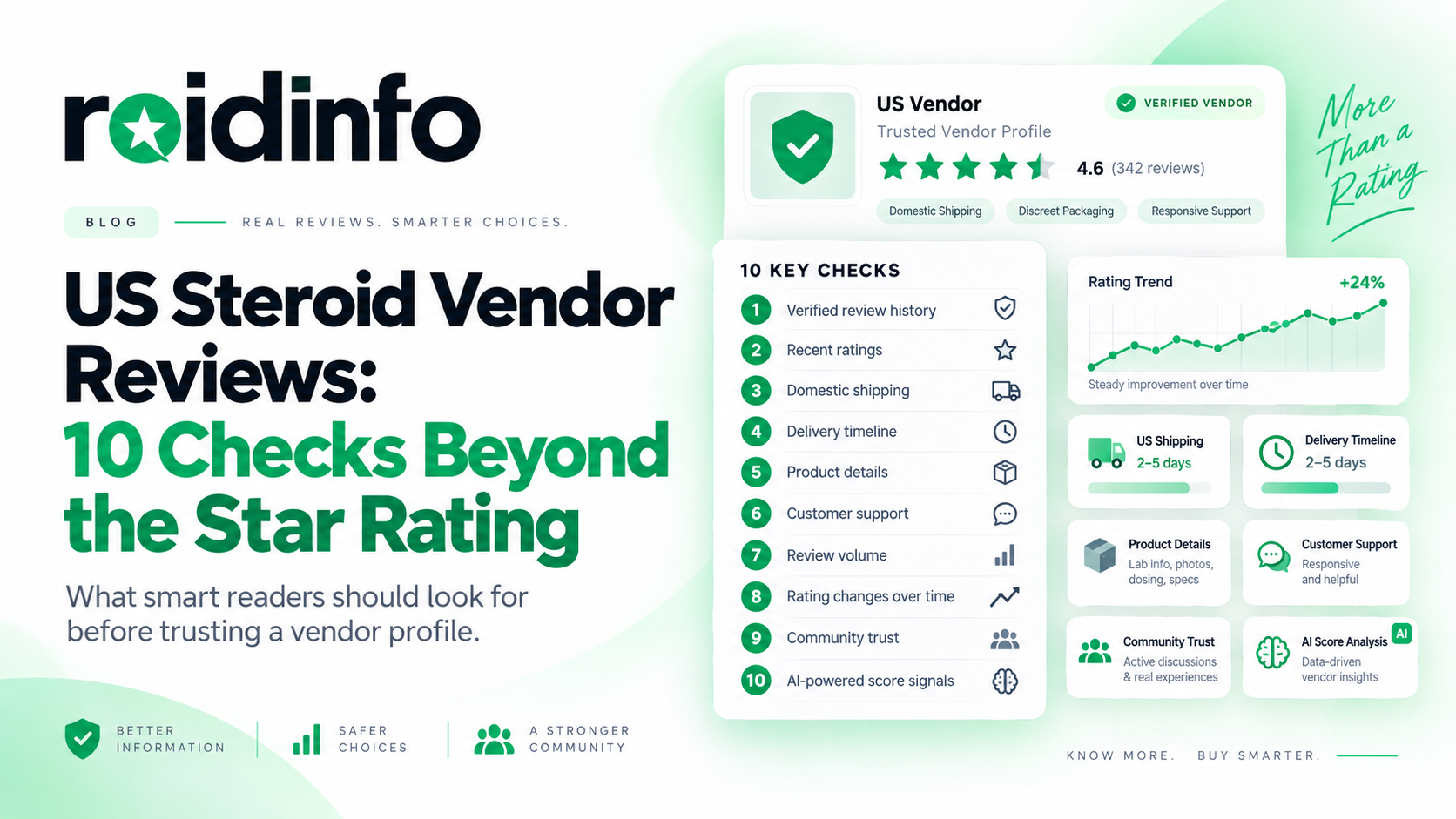
“Reliable” can mean several things in a vendor review. One person means a package arrived. Another means a support message received an answer. A third is repeating a reputation they have heard about elsewhere.
Those statements should not carry the same weight.
Reading US steroid vendor reviews carefully means separating what a reviewer experienced from what they assumed. A useful profile gives you enough detail to understand the rating: when the experience happened, what went wrong or right, and whether any unresolved questions remain.
The following ten checks focus on the credibility of that record. They are not a vendor ranking, and customer feedback about delivery or service should not be mistaken for evidence of a product’s medical safety.
Start with the verification process, not the badge. Has the platform confirmed an email address, checked evidence of an order, or reviewed the submission for compliance with its rules? These are different checks, and they establish different things.
An order record can support a claim that a transaction took place. It does not automatically confirm every statement the reviewer makes about the product or the business. Likewise, a verified email address should not be read as a verified purchase.
Then examine the history itself. Does the reviewer describe a particular experience, including the problem and its outcome? Does a later update clarify an earlier complaint? A sequence you can follow is more informative than an unexplained endorsement.
Keep the limits in view. Detailed writing can still be invented; a brief comment can still be honest. Verification matters most when you understand what was checked and what remains unconfirmed.
A long standing reputation can dominate a profile even when its newest reviews tell a different story. Before accepting the overall score, read the latest substantive comments and note when the experiences occurred.
The publication date is only part of that check. A review posted this week may describe an order from several months ago. Where the timing is unclear, do not assume the comment reflects current performance.
Pay particular attention to updates. An unresolved complaint and the same complaint followed by a confirmed resolution are not equivalent records. The original rating may remain visible even after the circumstances change.
This step is about understanding the most recent evidence available. Whether it represents a lasting improvement or decline is a separate question, addressed by the longer term pattern.
“Domestic shipping” needs context. Does a review describe the delivery experience the customer actually had, or simply repeat wording from a listing?
Look at the scope of the statement. A reviewer may report receiving a parcel at a US address without establishing where it originated. A profile may also contain experiences from different locations or service arrangements. Treating them as interchangeable can produce a misleading impression.
A useful comment identifies what happened within that particular transaction. A broad claim about all US deliveries goes further than one customer’s experience can support.
Keep shipping feedback in its own category. It can describe a service event; it cannot establish the authenticity or safety of the contents. The word “domestic” does not change that distinction.
Delivery comments often use different starting points. One reviewer counts from the moment they placed an order. Another starts when dispatch was confirmed. Both may report their experience accurately while describing different intervals.
Consider a hypothetical comparison: one comment says “three days after dispatch,” while another says “a week from ordering.” Without knowing the processing time in the first account, there is no sound basis for calling one experience faster.
Read for the stages the reviewer actually describes: processing, tracking updates, and arrival. Missing information should remain missing information, rather than being filled in with an assumption.
Consistency is about whether comparable accounts tell a similar story. One unusually quick arrival or one unexplained delay is not enough to establish a general pattern. Repeated gaps in the same stage are more informative than the shortest delivery time on the page.
Specific product information helps you understand the scope of a review. A category, brand name, stock issue, packaging description, or account of an incorrect item can explain why someone chose a particular rating.
Those details have limits. Saying that a label matched a listing is different from establishing what a product contains. Describing intact packaging is different from verifying product quality.
Read broad claims against the experience provided. If a review discusses only presentation and delivery, it has not explained the basis for a much wider endorsement. A brand name alone does not supply the missing evidence.
For US steroid vendor reviews, this boundary deserves particular care. Customer accounts are not laboratory results or medical assessments. Product details can make a transaction easier to understand without turning that transaction into proof of safety or effectiveness.
“Support replied quickly” leaves an important question unanswered: what did the reply achieve?
A response can acknowledge a message without addressing its substance. To understand the service experience, follow the issue through the review. What was unclear? What did support explain? Did the customer later report a resolution, or only another promise?
A hypothetical account saying “They answered within an hour but never clarified the missing item” describes something quite different from a simple compliment about response speed.
Business replies deserve the same attention. A calm, polished message may be helpful, but it remains one side of the exchange. Check whether it addresses the complaint and whether any later update confirms what happened.
An unresolved disagreement should remain an unresolved disagreement. Neither a confident accusation nor a professional response settles the facts by itself.
Five reviews and five hundred reviews offer different amounts of material to examine. That does not make the larger collection automatically independent, representative, or reliable.
Look at how contributions are distributed. Are there distinct experiences over time, or a short burst of similar comments? Do several posts describe separate transactions, or repeat the same incident? A higher count is less informative when it gives the appearance of multiple experiences without actually adding them.
A quiet profile requires restraint too. Little recent activity means there is less visible evidence; it does not explain why. Avoid turning an absence of comments into either reassurance or an accusation.
The platform’s collection rules matter here. Our Review Guidelines set out a one review per order policy, prohibit paid or incentivized submissions, and describe human moderation before publication. These rules explain how contributions are supposed to be handled; the review count alone cannot tell that story.
Recency gives you a current snapshot. A rating history, where available, helps you examine direction.
A decline deserves closer reading, not an automatic conclusion. Did several recent reviewers describe the same unresolved problem? Did a small number of new ratings move a profile with very little previous feedback? Was the score calculated differently during the period being compared?
The same questions apply to an improvement. A rising number is more meaningful when the accompanying comments explain what improved, rather than offering a fresh set of general endorsements.
Older reviews can also dilute the numerical effect of newer complaints. A stable overall average does not necessarily mean the recent experience is unchanged.
Where historical scores are unavailable, use dated comments cautiously. They may suggest a pattern, but they do not reconstruct a complete rating history. Be clear about the difference between an observable change and an impression drawn from a few posts.
Community discussion is useful when different people contribute their own experiences. Repetition is less helpful when everyone is referring back to the same original claim.
Follow the basis of the agreement. Do several reviewers describe distinct events that support a similar conclusion? Or do comments simply repeat that a vendor is “well known” or “trusted” without explaining why?
Helpful votes can show that a contribution resonated with other readers. They do not establish that those readers checked its accuracy. An established username also deserves to be read on the strength of the particular account, rather than reputation alone.
Disagreement can be informative. Two customers may have different experiences without either account being false. A credible discussion leaves room for those differences instead of requiring every contributor to reach the same verdict.
For a closer look at misleading patterns, our article on how fake reviews erode trust explains why convincing language and apparent consensus are not enough to establish authenticity.
An AI powered score still needs an explanation. Before giving it weight, find out what is being scored: the reviewer’s rating, the quality of the written submission, or a combination of the two.
These are not interchangeable measures. A system can assign more influence to one review than another without independently confirming every claim in either review.
Our explanation of how review scores work describes contact verification and a weighted calculation in which AI quality scores affect each review’s contribution to the overall source score. Read that methodology alongside the individual comments, not instead of them.
For any scoring system, ask whether its published explanation identifies the inputs and weighting clearly. Do not assume that review freshness, community votes, or purchase evidence are included merely because they would be useful signals.
The resulting number can summarize an assessment of feedback. It does not turn customer statements into independently established facts, certify a product, or guarantee what will happen next.
You now have a framework for reading reviews more critically. Put it into practice on roidinfo: examine the experience behind a rating, look for clear explanations, and consider what the reviewer hasand has not established.
Apply the same scrutiny to the platform itself. Our review and scoring process explains how feedback contributes to a source’s overall score, while our Review Guidelines set out the standards for submissions and moderation. These pages are a starting point for understanding our approach, not a reason to stop asking questions.
We invite you to take a closer look at roidinfo rather than take our word for it. Read the individual accounts, compare the evidence, and decide how much weight each review deserves. Trust in a review platform should be earned through a process readers can understand not claimed in a headline.